

In 1975, a 775-word letter began arriving in mailboxes across the United States. It opened with a simple scene: two young men graduating from the same college on a beautiful spring afternoon.
Over the next twenty-eight years, that single piece of direct mail would generate an estimated $2 billion in subscription revenue for The Wall Street Journal, making it one of the most profitable advertisements ever created.[1][1] SOFII. “The Most Successful Advertisement in the History of the World.”
It’s now known as the “two men” sales letter, and understanding its simplicity can help you harness the power of story.
Key Takeaways
- The Wall Street Journal’s “two young men” letter, written by copywriter Martin Conroy, ran from 1975 to 2003 and generated roughly $2 billion in subscription revenue.
- The letter’s power comes from narrative contrast: two similar men with divergent outcomes, a technique rooted in decades of direct-response advertising.
- Conroy adapted the concept from earlier advertisements for the Alexander Hamilton Institute, demonstrating how proven frameworks can be refined across eras.
- Storytelling activates cognitive processes that make audiences more receptive to a message, according to research from Northwestern University’s Kellogg School of Management.
- The letter’s principles—simple narrative, emotional contrast, and a clear value proposition—remain foundational to copywriting today.
The letter that launched a billion-dollar run
Behind every good ad is some creative person who was in the zone.
In this case, it was Martin Conroy. He was a veteran advertising executive at BBDO when he wrote what would become the most celebrated direct-mail piece in history. A graduate of the College of the Holy Cross with a bachelor’s degree in English, Conroy honed his craft at Bloomingdale’s (humble retail beginnings, unite! pumps fists) and on the editorial staff of Esquire magazine before joining BBDO in 1950, where he eventually became a vice president.
The letter itself is deceptively simple. It describes two men who graduated from the same college twenty-five years earlier. Both were married, both had children, and both had gone to work for the same manufacturing company after graduation. But at their twenty-fifth reunion, one man was the manager of a small department, while the other was the company’s president.
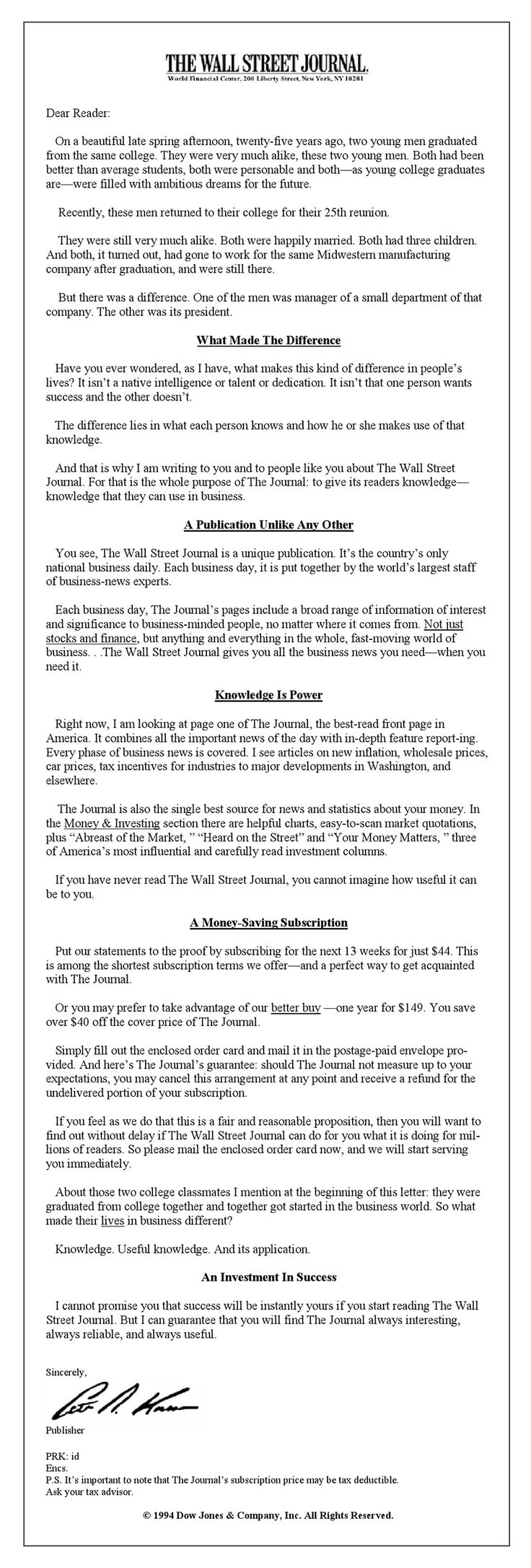
The letter then poses the question every reader would naturally ask: What made the difference? The answer, of course, was The Wall Street Journal. The successful man had made a habit of reading it, gaining the knowledge and perspective that propelled his career forward.
Direct marketing analyst Axel Andersson later calculated that dividing the letter’s two-billion-dollar revenue by its 775 words yields roughly $2.58 million per word.[2][2] Swiped.co. “$2 Billion Wall St. Journal Letter (Tale of Two Young Men) by Martin Conroy.” (Of course someone in marketing did this.) With only minor edits over its lifespan, the letter was mailed to millions of prospective subscribers from 1975 until 2003, when the Journal finally retired it.
Copywriters loooooove telling this story because it proves the financial power of great writing and storytelling.
Why the narrative works
The two men sales letter succeeds because it leverages one of the most potent tools in persuasion: storytelling.
Research from Northwestern University’s Kellogg School of Management has shown that narratives engage audiences in ways that straightforward arguments cannot. When people are absorbed in a story, they are less likely to scrutinize the underlying claims and more likely to be persuaded by the message.[3][3] Kellogg School of Management at Northwestern University. “Stories Can Be Powerful Persuasive Tools.”
This phenomenon, known in academic literature as narrative transportation, has been studied extensively. A neuromarketing study published in the Journal of Retailing and Consumer Services found that storytelling significantly increases both persuasion and information retention compared to purely factual presentations.[4][4] ScienceDirect. “Storytelling the Scale of Persuasion and Retention: A Neuromarketing Approach.” When readers follow characters through a narrative arc, they engage emotionally, and that emotional engagement creates a receptive state for the call to action that follows.
Conroy’s letter does this masterfully. Rather than listing the benefits of a Wall Street Journal subscription — market data, business analysis, career insights, blah blah blah — he wraps the value proposition inside a story about two real-seeming people. The reader identifies with the characters, feels the tension of divergent outcomes, and arrives at the conclusion that the Journal is worth subscribing to before the letter even makes the explicit ask.
The letter is a good example of pathos, the literary and rhetorical device that wins people over by making them feel something.
Borrowed brilliance: The Alexander Hamilton Institute connection
The two men letter’s concept was not entirely original. Advertising historians have traced its narrative back to campaigns created for the Alexander Hamilton Institute, a business correspondence school that operated from 1909 through the 1980s.[5][5] Swiped.co. “Men Who Know It All Ad by Bruce Barton (for Alexander Hamilton Institute).”
Bruce Barton, one of the founders of the advertising agency BBDO (the same firm where Conroy would later work), wrote advertisements for the Alexander Hamilton Institute in the 1920s and 1930s that used a strikingly similar premise. One example was the “Men Who Know It All” campaign, which positioned the Institute’s coursework as the differentiator between professional mediocrity and success. The ads targeted ambitious men who felt stuck in their careers, promising that the right education would set them apart.
Conroy, whether consciously or through the osmosis of working within the same agency’s creative tradition, adapted this proven framework for a new product and a new era.[6][6] Breakthrough Marketing Secrets. “The World's Greatest Sales Letter (That Wasn't).”
Lessons and takeaways
Though the two men sales letter is a product of the direct-mail era, its underlying principles translate across channels and decades. The letter follows a structure that any inverted pyramid devotee would recognize as effective: lead with the most compelling element first, then layer in supporting detail. In this case, the story is the hook.
The letter opens with a specific, visual scene. “On a beautiful late spring afternoon, twenty-five years ago, two young men graduated from the same college.” This is not an abstraction; it is a moment the reader can picture.
It also establishes similarity before introducing contrast. The two men are alike in nearly every respect before their paths diverge. This makes the eventual difference feel meaningful rather than arbitrary.
The two men letter skillfully delays the product mention. The Wall Street Journal does not appear until the letter’s midpoint, after the reader is already invested in the story. By the time the product enters the frame, the reader wants to know what caused the difference, and the Journal becomes the answer to a question the reader is already asking.
The call to action is then framed as an invitation rather than a hard sell. The letter offers a trial subscription, reducing the risk and making it easy for the reader to say yes.
These structural choices are not accidents. They reflect a deep understanding of how people process information and make decisions. Even in an era dominated by digital marketing, direct mail continues to perform. Research from MIT Sloan Management Review has noted that physical mail holds a reader’s attention significantly longer than digital alternatives, making the channel a powerful complement to online strategies.[7][7] MIT Sloan Management Review. “How Direct Mail Delivers in the Age of Digital Marketing.”
A legacy about, and beyond, words
Martin Conroy died on December 19, 2006, in Branford, Connecticut, at the age of eighty-four. His obituaries noted his long career at BBDO, his eight children with his wife Joan, and this dang letter. The two men letter remains a touchstone for anyone who studies persuasion, direct response, or the craft of writing that sells.
The two men sales letter endures not because it was flashy or clever, but because it was clear, human, and grounded in a narrative structure that people have responded to all throughout history.