
Writing a book kinda breaks you
Voice and style now that AI is here to stay


The worst of the heat is over here in the U.S., and a Spirit Halloween popped up near my neighborhood last week, which can only mean one thing: Autumn has arrived. Now pass the maple/pumpkin-flavored beverages, please.
In this newsletter:
- A blog about writer's block
- A new Out finance column
- Website portal updates
If you found this newsletter interesting, forward it to a friend. And if you were forwarded this newsletter from someone who cares about you (☺️), you can sign up by clicking here.
—Nick

Writing a book kinda breaks you
Voice
Writing my first book Money Proud in 2024 kind of broke me as a writer. At the time, I'd written and edited online for about ten years, in a variety of formats. Financial news, tech news, sales pages, newsletters, some executive ghostwriting (shudder), and the like. I mainly wrote stuff meant to be consumed on the internet, and would consider that the bulk of my professional writing experience.
A book manuscript is the opposite of all this. It doesn't matter if the subheadings are formatted correctly to swoon Google's crawl bots, or if the newsletter font size is too small on a phone, or if we answered who-what-where-when-why-how in the first few paragraphs. In a book manuscript, it's just you, an idea, and a blank page. Many blank pages. Books are long AF. Books are marathons.
Writing a book for a big publisher forced me to step up my creative process. It wasn't enough to simply organize financial information and mix in a few funnies. I had to clarify a style of writing that is interesting and personality-forward. A voice. (Cue NBC 'The Voice' jingle) I'd previously had glimmers of this voice in my writing, mostly in finance columns for Out magazine. But in writing Money Proud, my repeatable recipe emerged.
Cooking this voice takes time. The meat has to marinate for hours. The dressings and sauces are made from scratch. And we're obviously gonna plate the bejesus outta this entrée so that we can take a photo of it to share later (or just let it join our phone's photo hoard). My creative process takes longer now, and is better, but also slower.
It was easy to access this voice in Money Proud because I spent many months stewing over the same passages. I would wake up in the middle of the night thinking things like "I should absolutely joke about Warren Buffett's morning sausage-egg-and-cheese order at McDonald's when I introduce investing" (page 151). The zingers flowed. But when I went back to writing articles and newsletters, and tried to follow my fancy new voice recipe, it didn’t work. Everything I wrote, um… sucked?!
The ideas were half-baked. The paragraphs were flat. And where were all the JOKES?

Then I went back and looked at all the stuff I'd written and published on the internet over the years. And I realized it wasn't that my writing sucked. (A lot of it did, though. It's fine! We can laugh about it now!) It's that my voice is clearer now, so anything with my name on it that doesn't have my special sauce feels a bit weird. I can get the voice in my head onto the page, which is exciting.
AI
Parallel to all of this is AI rapidly disrupting the information landscape in a number of ways. I had a conversation with an editor friend earlier this year in which he pointed out that the news stories he wrote would get sucked into AI-generated summaries same-day, often with his writing cited verbatim, but not attributed by name. He was laid off a month later.
I'm thinking a lot about the types of writing AI can't do. Journalism. Interviews. Context. And yes, voice and style. ChatGPT can out-write me, but it can't out-gay me. Organizing information, which AI now does on command with varying degrees of accuracy, is part of developing and telling a story. But storytelling has many other elements: rhythm, mechanics, speed, tension. Perspective. In a story, there is emotion. There's humanity. And our humanity might be all we have left soon.
Then there’s all the fake social proof. Consultant Eric Schwartzman’s Fast Company piece "Bot farms invade social media to hijack popular sentiment" has been on my mind since it first came out last April. Now that bot farms have AI, they can just give the bots personalities and let the bots lurk for months, building up data footprints that make them imperceptible to most social media platform bot filtering systems. Since engagement is what determines distribution on most platforms, the synthetic engagement of bot farms can juice performance and sway public perception. It’s like steroids for content, if you will.
I recently came across a prominent personal finance creator on YouTube who had just published a new video about Roth IRAs. The video itself was fine. But it had only been up for an hour or two, and already had several hundred thousand views and over 2,000 comments, many from user accounts that had only been created in the last few weeks.
It's too hard to try and compete with these people through productivity. (When would I nap?) You have to do something more, or different, or better. You need voice.
Video
Yas! Voice! Style! Except, uh… (shuffles messy desk) I'm still working through this writer's block-voice thing. Can't seem to shake it. So I tried something different to get myself moving again: vertical video.
Social media has always felt like building on rented land. It seems to bring out the worst in people, and AI is now almost certainly making every platform worse. But I acknowledge video is the future, and these platforms are where a lot of discerning people hang out, even if they only ever lurk. I like that there is scripting, which gets me writing, but then there are other elements, and you have to get them all to work together.
I've scripted videos about finance and news and LGBTQ+ stuff. Lately, I've been doing a weekly series on gay history for storytelling practice. (How much story can I tell in 350 words?) This gives me practice in organizing information as well as video editing; I took some film classes during my journalism certification at UCLA back in 2023, and fell hard for video. So many elements to appreciate. And yet, my best videos are the ones where I took my time and let my voice cook all the way through. I see history as an aspect of personal finance in that it shows us how people before us lived their lives, which then gives us insight into how we might like to live ours with the time we have remaining.
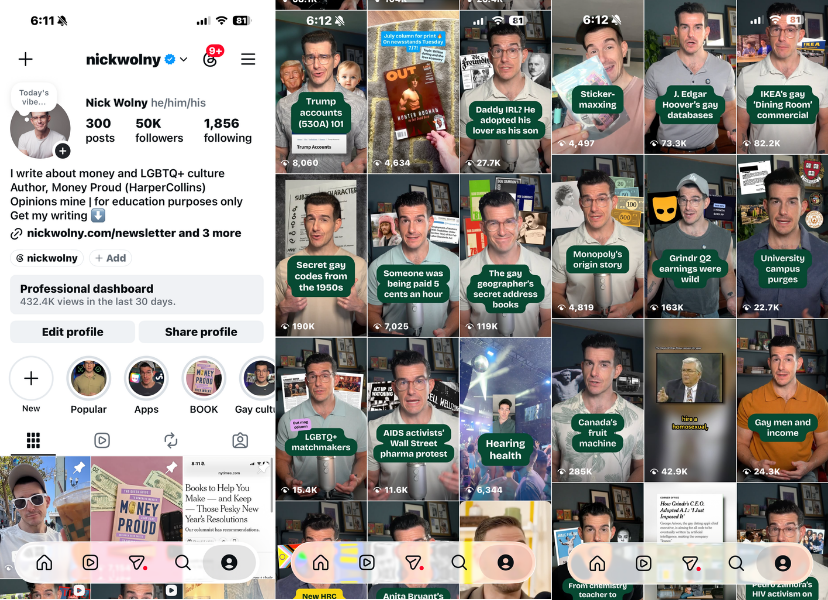
I've stopped making myself wrong about not writing enough, and am allowing the writer's block to run its course. But I do feel ready to write again. I wrote this, and wanted to. And I've been working on my website a lot this year in preparation for when I resume. More on that later. It's interesting how homeownership motivates you to make the other spaces in your life more welcoming, too.
Have you been thinking about any of this stuff as well? Reply and let me know. ⬥

401(Gay)
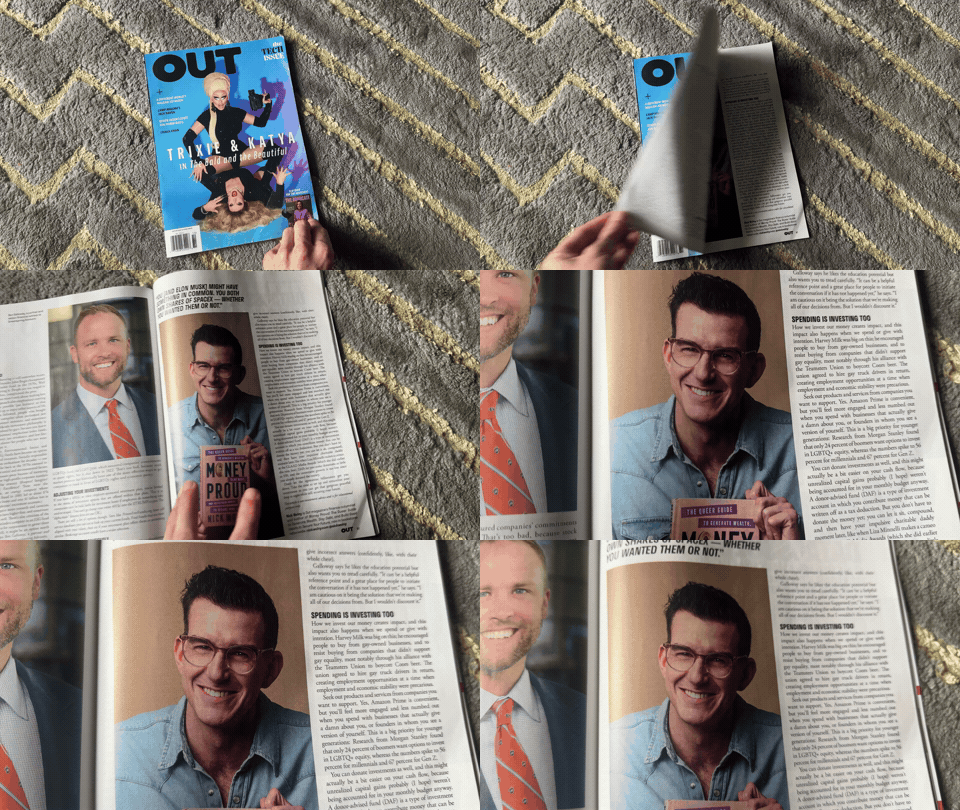
For Out magazine, I wrote about funds in retirement accounts, SpaceX's attempt to fast-track into the S&P 500, and how AI is changing retail investing. SpaceX ended up not getting fast-tracked, though it is in the NASDAQ. Oh the joys of writing for print, where you submit three months out! 🤪
TL;DR; you can be hands-off with investing, but if the ethics of the companies keep you up at night, there are resources to help you research more ESG-oriented funds (although the integrity of ESG funds themselves is sometimes also contested).

Editor's note: Website portal
Did a lot of website work this summer. One aspect of this was to create a subscriber portal within my website, which you all have access to now. Just send yourself a sign-in link to get logged in, no password needed. (Your data is never shared.)
I did this because I want to be able to publish subscribers-only stuff on my own tech stack.


Comments
Loading comments...