
The new economics of pride
Also: debt downgrade sass, ambient livestream recos, and a great Harvey Milk speech


I write two types of articles for Out magazine.
The print column, which is further down in this email, has a tighter focus. It's reported, about 1,500 words in length, and hits on big-picture topics or ideas. Out's physical magazine is bimonthly, and one issue is dedicated entirely to the Out 100, so I do a total of five print columns per year, the most recent of which came out this week.
The digital column is weekly and more experimental. We look for ways to piggyback on current news events. This is a strategic contrast to print, which is challenging because it has to feel fresh while also being written months in advance (My latest story, which came out this week, was submitted in mid-March).
Example: This week's assignment was to write a 700-word explainer on the debt downgrade, targeted toward queer people who have no clue what a debt downgrade means, but might be stressed by the news about it. Would love to hear how you think I did; I put the start of it below.
If you're writing and publishing online, be intentional about whether your topic is timely or evergreen. Both approaches work, but have different workflow nuances. Evergreen content is about depth, whereas timely content is more about speed. Experiment with each to see what you like.
---
What Moody's U.S. debt downgrade means for your gay wallet
Earlier this week, credit rating agency Moody’s downgraded its rating on America's debt, and discerning gays like myself have questions. Who does Moody’s think she is? What the hell does a downgrade even mean? And was the federal government getting 3 percent cash back on all that spending – or at least a few extra airline points?!
It’s hard to clutch our pearls at the news when we don’t quite understand what’s happening. And what’s tricky is we can’t really compare a government’s debt to a personal budget; they’re two very different things, influenced by very different economics.
Most of us don’t need to totally stay on top of this macroeconomic realness in our day-to-day-lives, but like tariffs, a debt downgrade could have ripple effects in areas like inflation, mortgage rates, and credit cards, so let’s go through what it all might mean for your wallet.
What is the national debt?
(sips martini) Mmkay, so the U.S. government creates policies and programs, and all that stuff costs money. Like a lot of us, America sometimes goes over budget on its spending, so it has to borrow money to cover the costs. To do this, the Treasury sells bonds. You buy a bond and get paid interest on it while you hold it, then get your initial money back when the bond matures. About a quarter of our debt is owned by foreign investors, including other countries’ governments.
Currently, our national debt is just over $36 trillion, which is a shit-ton of money. There’s a limit on how much money the government can borrow, but Congress can increase this limit if it wants. This is called the debt ceiling, and every couple of years Congress inevitably votes to kick the can down the curb and increase the debt ceiling to avoid a meltdown.
What does the downgrade mean?
Investors can point to the downgrade as evidence to not buy bonds in the future. But Moody’s is one of a number of credit agencies; S&P already downgraded the U.S. back in 2011, and Fitch downgraded us in 2023, so it’s not like Moody’s has “Joaquin Phoenix in Gladiator”-level authority. The downgrade creates leverage for both domestic and foreign investors. They can say “babe, your rating’s not as good; if you want me to buy more bonds, you need to offer me a better interest rate.”
...
🔗 Continue reading at Out Magazine

Out Magazine print column

The new economics of pride
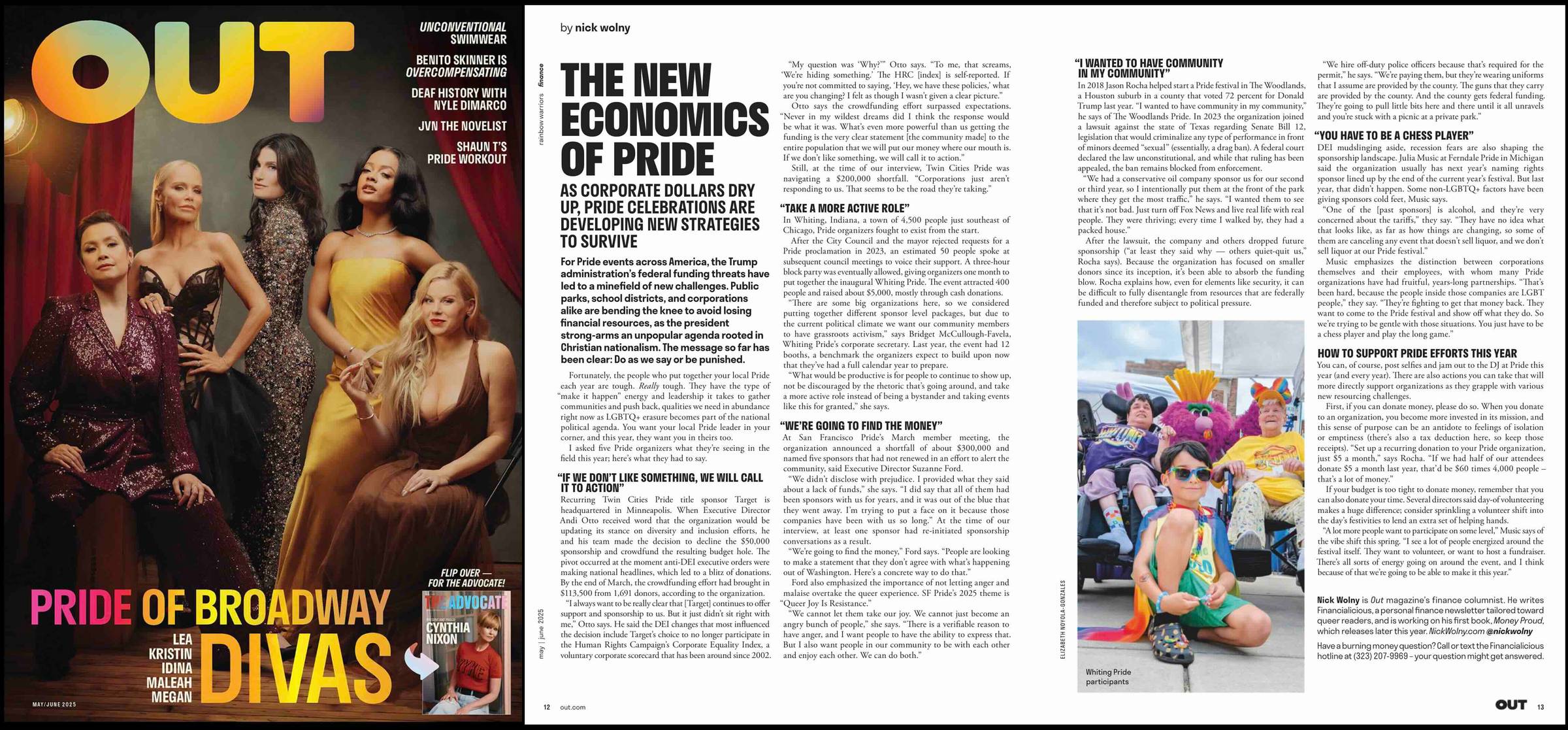
For Pride events across America, the Trump administration’s federal funding threats have led to a minefield of new challenges. Public parks, school districts, and corporations alike are bending the knee to avoid losing financial resources, as the president strong-arms an unpopular agenda rooted in Christian nationalism. The message so far has been clear: Do as we say or be punished.
Fortunately, the people who put together your local Pride each year are tough. Really tough. They have the type of “make it happen” energy and leadership it takes to gather communities and push back, qualities we need in abundance right now as LGBTQ+ erasure becomes part of the national political agenda. You want your local Pride leader in your corner, and this year, they want you in theirs too.
I asked five Pride organizers what they’re seeing in the field this year; here’s what they had to say.
“Take a more active role”
In Whiting, Indiana, a town of 4,500 people just southeast of Chicago, Pride organizers fought to exist from the start.
After the City Council and the mayor rejected requests for a Pride proclamation in 2023, an estimated 50 people spoke at subsequent council meetings to voice their support. A three-hour block party was eventually allowed, giving organizers one month to put together the inaugural Whiting Pride. The event attracted 400 people and raised about $5,000, mostly through cash donations.
“There are some big organizations here, so we considered putting together different sponsor level packages, but due to the current political climate we want our community members to have grassroots activism,” says Bridget McCullough-Favela, Whiting Pride’s corporate secretary. Last year, the event had 12 booths, a benchmark the organizers expect to build upon now that they’ve had a full calendar year to prepare.
“What would be productive is for people to continue to show up, not be discouraged by the rhetoric that’s going around, and take a more active role instead of being a bystander and taking events like this for granted,” she says.
...
🔗 Continue reading at Out magazine

Money vocab
Tip of the week: Average v. median
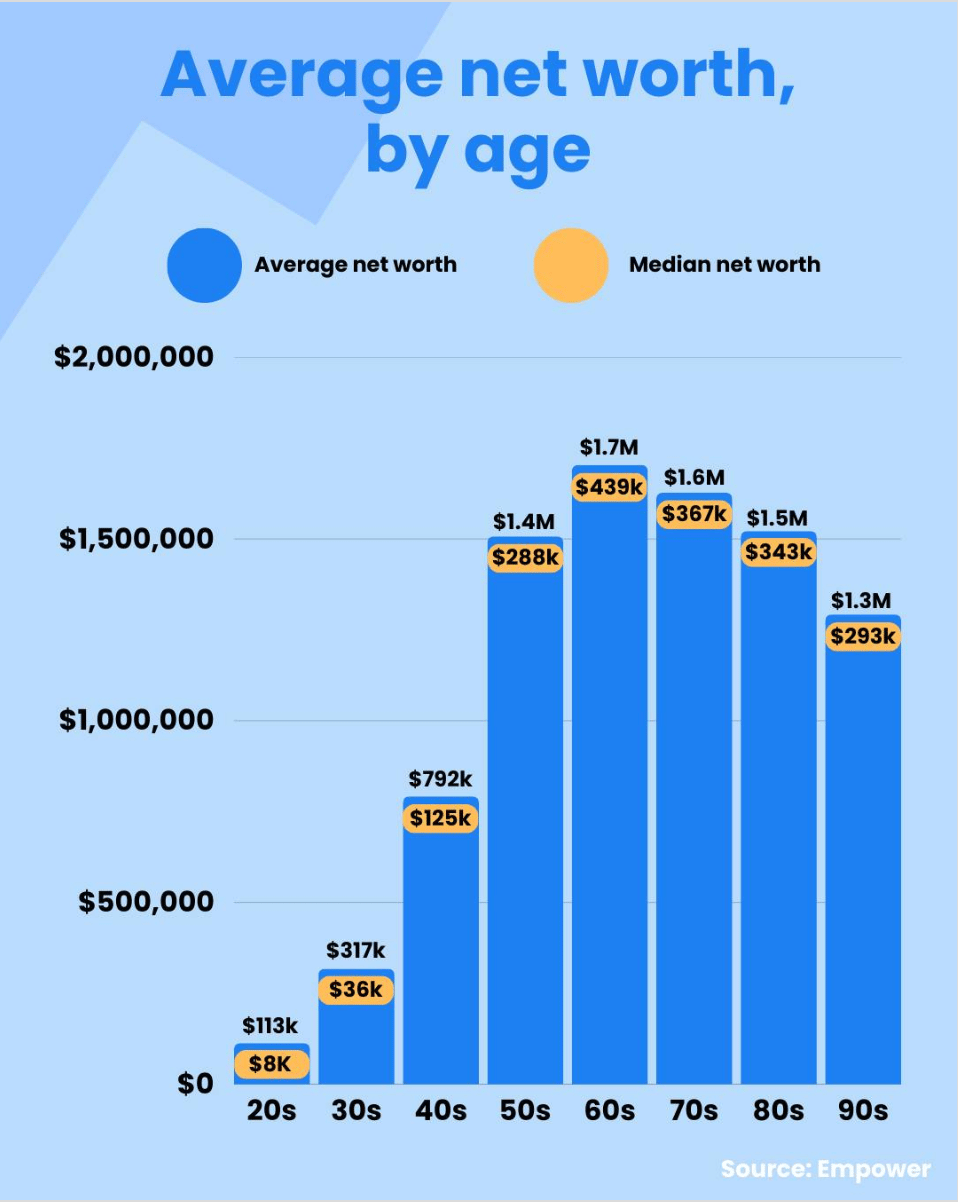
I liked this graphic on Morning Brew's Instagram. "Average" is a slippery term in finance because ultra-rich people's wealth can throw numbers off.
Median, the midline that separates the top and bottom 50% of the data set, often paints a clearer picture.
Here, average net worth is presented in blue, whereas median net worth for the given age bracket was denoted in yellow.

Hot Links
What happened this week
Disclosure: I work for Ziff Davis, the parent company of CNET, Mashable, PCMag, Lifehacker, and ZDNET, and equalpride, the parent company of Out magazine and The Advocate.
--
A little tired, so it's a short list this week. 🙏🏼
--
LGBTQ+
A GOP lawmaker was left speechless when asked if he was trans during a hearing. lol. (Greg Owen / LGBTQ+ Nation)
A new study estimates that over 185,000 transgender adults rely on Medicaid for health insurance. (The Williams Institute)
Three men were sentenced to life in prison for the New York City drugging, robbing, and killing of two gay men in 2022. District Attorney Alvin Bragg was heavily criticized for dragging his feet in the case. (Christopher Wiggins / The Advocate)
Social media and pop culture
A Step-by-Step Guide to Planting Your Summer Vegetables. (Amanda Blum / Lifehacker)
Ambient streaming idea: Watch the International Space Station's hourslong livestream of Earth. (Mashable)
Mashable Perspectives, a new franchise at Mashable,debuted. Shameless plug: My team launched this franchise at Mashable this week, we've been working all year on it. Feeling like a proud editor-dad.
Perspectives focuses on commentary from non-staff contributors. A few of my faves:
- My grief journey: How I got lost in nostalgia to cope with my loss. (Hiko Mitsuzuka)
- I'm a college writing professor. Here's what AI still can't do. (Jonathan D. Fitzgerald)
- How a Threads post helped me find community and beat loneliness. (Vee Weir)
- Also, this piece from Hiko on the 30th anniversary of the Melrose Place pipe bomb storyline, because we have to educate the young people!
Nick's pick
My name is Harvey Milk and I'm here to recruit you. That's the opening sentence of a speech Harvey Milk gave at the March 10, 1978 meeting of the gay caucus of the California Democratic Council in San Diego, the transcript of which was reprinted in the Bay Area Reporter this week for Harvey Milk Day. (Bay Area Reporter)

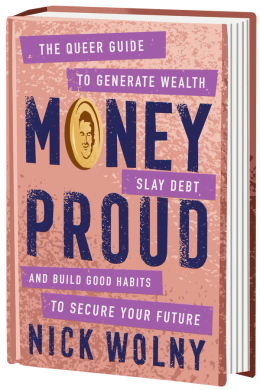
Order MONEY PROUD today!
Learn more about Nick's debut book, which The New York Times called "A fun, well-written primer on a subject that's usually a snooze."
Learn more