
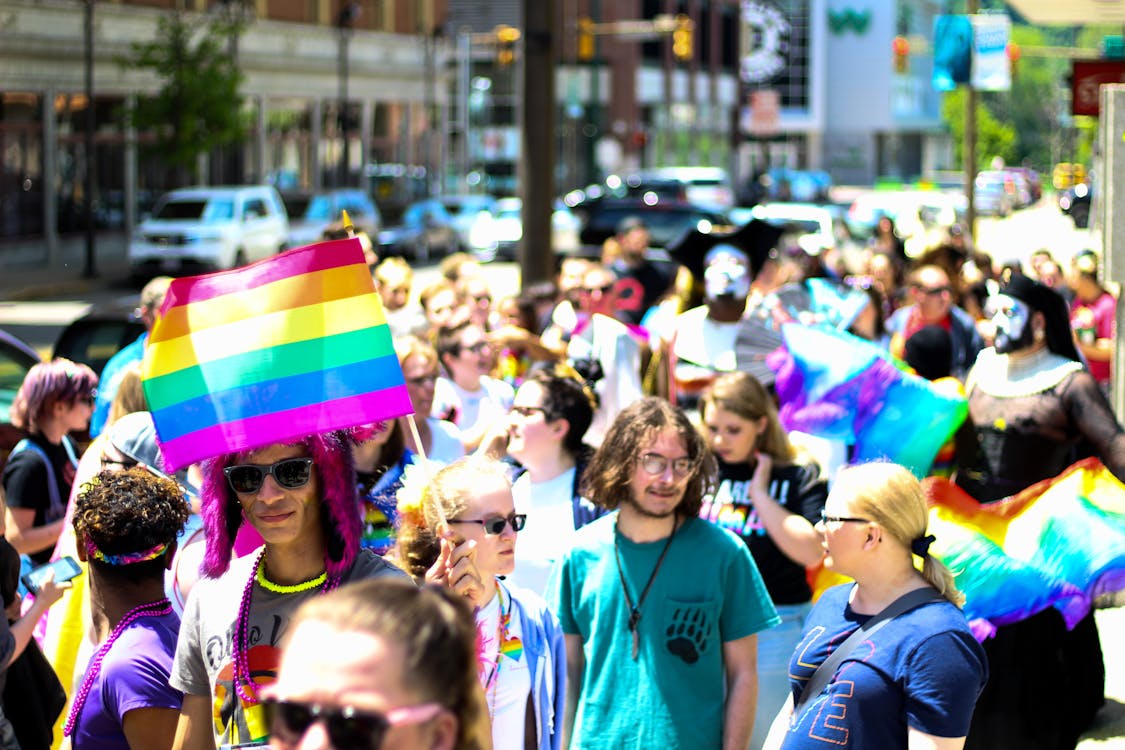
So how is money different for queer people, really? Well, for a long time, making money was harder for us then it should have been.
Society sees LGBTQ+ identity as controversial. Working while queer is controversial. Walking in nature while queer is controversial.
Eating a sandwich while queer is controversial (too bad, because you know it's gonna be a good sammie—panini press-toasted, artisanal pickles, the whole shabang). 🥪
Even just existing is controversial.
And without legal protections, people in power can use this “controversial” rhetoric to fire you and move on.
This holds LGBTQ+ people back financially. And many of these systems still exist today.
It's called workplace discrimination, boo-boo. And it comes in many forms.
- Getting passed up for the job
- Being boxed out from benefits because of your sexuality
- Being asked to tone down your natural appearance at work
- John in accounting being trash every single day and you not being able to say or do anything about it
It's BS!
There's also the less obvious stuff, like, oh, I don't know, how shitty discrimination makes us feel all the time.
Navigating day-to-day discrimination is draining. It affects your health and makes you want to numb out.
(And if you're a woman, person of color, and/or gender-nonconforming, the discrimination is multi-dimensional. A stressful 3-D, not the fun, trippy 3-D.)
Society perpetuates the idea that queer people are weak or mentally unfit. That prejudice then leaks into our lives in various ways that keep us broke.
The queer tax
Workplace discrimination is part of a larger headwind I once referred to as "The Queer Tax" in an article for Out magazine.[1][1] Out Magazine. “The Hidden Queer Tax.”
The queer tax includes the obvious stuff, like LGBTQ+ workplace and financial discrimination, that measurably affects our wallets.
It also includes the chronic minority stress that comes with being queer in a world that constantly tells us we're made wrong and don't belong.
And then there are the costs that come with our overcompensation in the face of all this—moving to cities with higher costs of living, seeking out affirming friend groups, exorbitant surrogacy costs, and so on.
Workplace discrimination is one of our biggest financial obstacles to topple. But to fight the employment systems that financially stunt queer people, we must first understand them, where they came from, and why they persist.
Y'all know I love a history moment, so grab those snacks now. 🍪 Here, we'll touch on notable points regarding LGBTQ+ workplace discrimination over the last 70 years, along with why economic parity matters.
Key Takeaways
- Employment discrimination compounds over a lifetime, contributing to the LGBTQ+ wage gap and lower retirement savings.
- Fear of financial retaliation kept queer people closeted for decades — coming out had and still has real impacts on one's livelihood.
- Nearly half of LGBTQ+ workers report experiencing workplace discrimination at some point in their careers.
How the Lavender Scare set the tone
Long before cringey corporate anti-harassment videos existed ("Martha called Andrew a f****t in the office... is this appropriate workplace behavior?"), the U.S. government was actively outing and removing LGBTQ+ people from federal employment.
During the Lavender Scare of the 1950s, thousands of government employees were fired or forced to resign because of their sexual orientation. A 1950 Senate report labeled queer people as security threats, and President Eisenhower’s Executive Order 10450 in 1953 formalized the ban on “sexual perverts” in federal service.
Related: 'The Lavender Scare' book report: Why the US government fired a bunch of queer people
Private employers soon followed the government’s lead. Being outed could end a career overnight, and the threat of exposure kept generations of LGBTQ+ workers closeted, isolated, and financially vulnerable. DL was necessary for survival.
State-level protections didn't come along until much later:
- Pennsylvania became the first state to ban sexual orientation discrimination in public employment in 1975.
- Wisconsin was the first to extend protections to both public and private sector workers in 1982.
- Minnesota was the first state to include gender identity in its nondiscrimination law in 1993.[2][2] Movement Advancement Project. “Employment Nondiscrimination Laws.”
But these were exceptions. For most of the 20th century, and in most of the country, firing someone for being gay, bisexual, or transgender was perfectly legal.
Harvey Milk and queer economic power
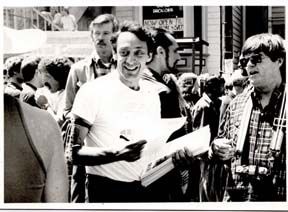
Much like other marginalized groups, LGBTQ+ communities began building their own economic infrastructure. One could argue that financial stability was a primary objective for the founding and development of gayborhoods. They somewhat functioned like mutual aid hubs back in the day.
The most notable example was San Francisco’s Castro district in the 1970s, where Harvey Milk turned a camera shop into the nerve center of a movement.
Milk opened Castro Camera in 1972, and the shop quickly became more than a business. It was a gathering place, a campaign headquarters, and a symbol that queer people could own and operate businesses openly.
Castro Camera, now a historical landmark in the Castro. Video from January 2026.
He cofounded the Castro Village Association, one of the first predominantly LGBTQ+ business associations in the country, and organized the Castro Street Fair in 1974 to prove to straight merchants that the growing gay community was good for the local economy.[3][3] Harvey Milk Foundation. “The Official Harvey Milk Biography.”
Teamsters Local 921
One of Milk’s most consequential economic moves was his partnership with organized labor.
When Teamsters Local 921 approached Milk about supporting a boycott of Coors beer, whose employment application openly asked applicants if they were homosexual, Milk mobilized the Castro’s bars, restaurants, and residents to refuse to buy or drink Coors. (This was part of a larger, decades-long union battle with Coors that had many elements.)
The Teamsters reciprocated by hiring openly gay truck drivers. It was one of the first examples of a labor union actively creating employment opportunities for LGBTQ+ workers.[4][4] Teamsters. “Teamsters Pride At Work: A Look Back At The Coors Boycott.”
The Castro model demonstrated something important: When queer people concentrated economic power, they could create jobs, negotiate with institutions, and build political influence.
Milk’s election to the San Francisco Board of Supervisors in 1977 was fueled in large part by the economic coalition he had spent years building.
His assassination in 1978 cut that momentum short. But the blueprint he created—using economic solidarity as a pathway to political power—influenced LGBTQ+ organizing for decades.
Related: What is pink money? A primer on LGBTQ+ purchasing power
HIV discrimination in the workplace
Just as LGBTQ+ communities were gaining economic footing, the AIDS epidemic devastated that progress. Beginning in the early 1980s, the crisis created an entirely new category of workplace discrimination that fell disproportionately on gay men.
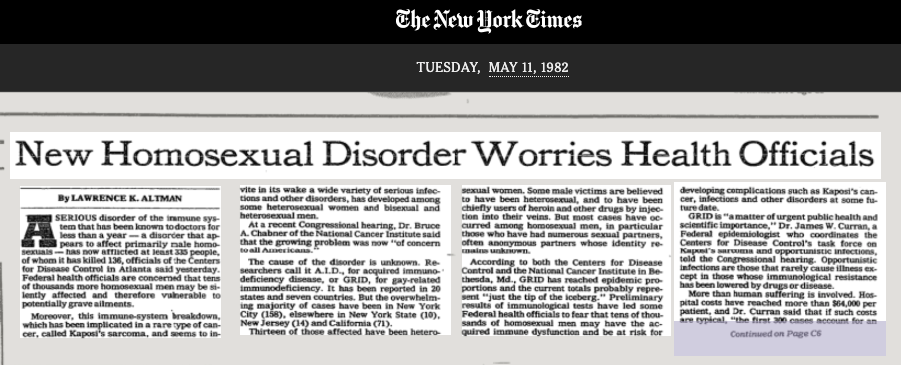
It really didn’t help that The New York Times initially labeled the disease “GRID”—Gay-Related Immune Disorder—which directly linked it to homosexuality in the public mind. That association gave employers a medicalized justification for what was often plain ol’ homophobia.
Workers were fired after testing positive, denied jobs based on perceived HIV risk, and pushed out of industries ranging from healthcare to food service to law. Polling from that era found that one in three Americans believed employers should be allowed to fire workers with AIDS.[5][5] Gallup. “Gallup Vault: Fear and Anxiety During the 1980s AIDS Crisis.”
Getting terminated after a positive test became so common that activists discouraged gay men from getting tested at all (!!!). Without treatment options, a diagnosis could end a career overnight.
Notable court cases on HIV-related workplace protections
- The Supreme Court ruled in 1987 in School Board of Nassau County v. Arline that contagious diseases could qualify as disabilities.
- The Americans with Disabilities Act of 1990 broadened protections to employers with 15 or more workers, but courts remained divided on whether asymptomatic HIV qualified.
- That question was not settled until Bragdon v. Abbott in 1998, when the Supreme Court ruled 5-4 that the ADA protects people with HIV whether or not they show symptoms.[6][6] Cornell Law Institute. “Bragdon v. Abbott.”
In the years between the first cases and the first legal protections, the financial damage compounded. Gay men lost jobs, housing, healthcare access, and family support simultaneously.
Between 1997 and 2014 alone, the Equal Employment Opportunity Commission (EEOC) received more than 4,000 charges alleging ADA violations based on HIV status. The true toll from the 1980s, before any federal framework existed, is harder to quantify, but almost certainly larger.
Author's Note:The EEOC paused processing LGBTQ+ discrimination claims in 2025 under the current administration.
The AIDS crisis also deepened the economic disadvantages that LGBTQ+ communities were already navigating. It wiped out savings, ended careers, and forced an entire generation of gay men to rebuild financially from scratch—if they survived at all.
The 2025 Matt Nadel documentary Cashing Out, available to watch on YouTube, examines how men with terminal AIDS diagnoses sold portions of their life insurance policies to investors in order to be named the beneficiaries.
Military discrimination
The military has its own history of LGBTQ+ employment discrimination, which continues for trans soldiers under the current administration.
This history matters because it continues to demonstrate a scenario in which Americans are promised government benefits, like veterans' benefits or tax benefits, then disqualified from those benefits because of their sexual orientation or gender identity.
- The Don’t Ask, Don’t Tell policy, enacted in 1993 under President Clinton, prohibited openly gay, lesbian, and bisexual individuals from serving in the military.
- Over its 18-year lifespan, DADT resulted in the discharge of more than 14,000 service members.[7][7] Human Rights Campaign. “Repeal of Dont Ask Dont Tell.”
- Many received Other Than Honorable or Entry-Level Separation discharges, cutting them off from VA healthcare, GI Bill education benefits, home loan programs, and burial benefits.[8][8] Legal Aid at Work. “LGBTQ+ Veterans Still Suffer Harms From Dont Ask Dont Tell Ten Years After Repeal.”
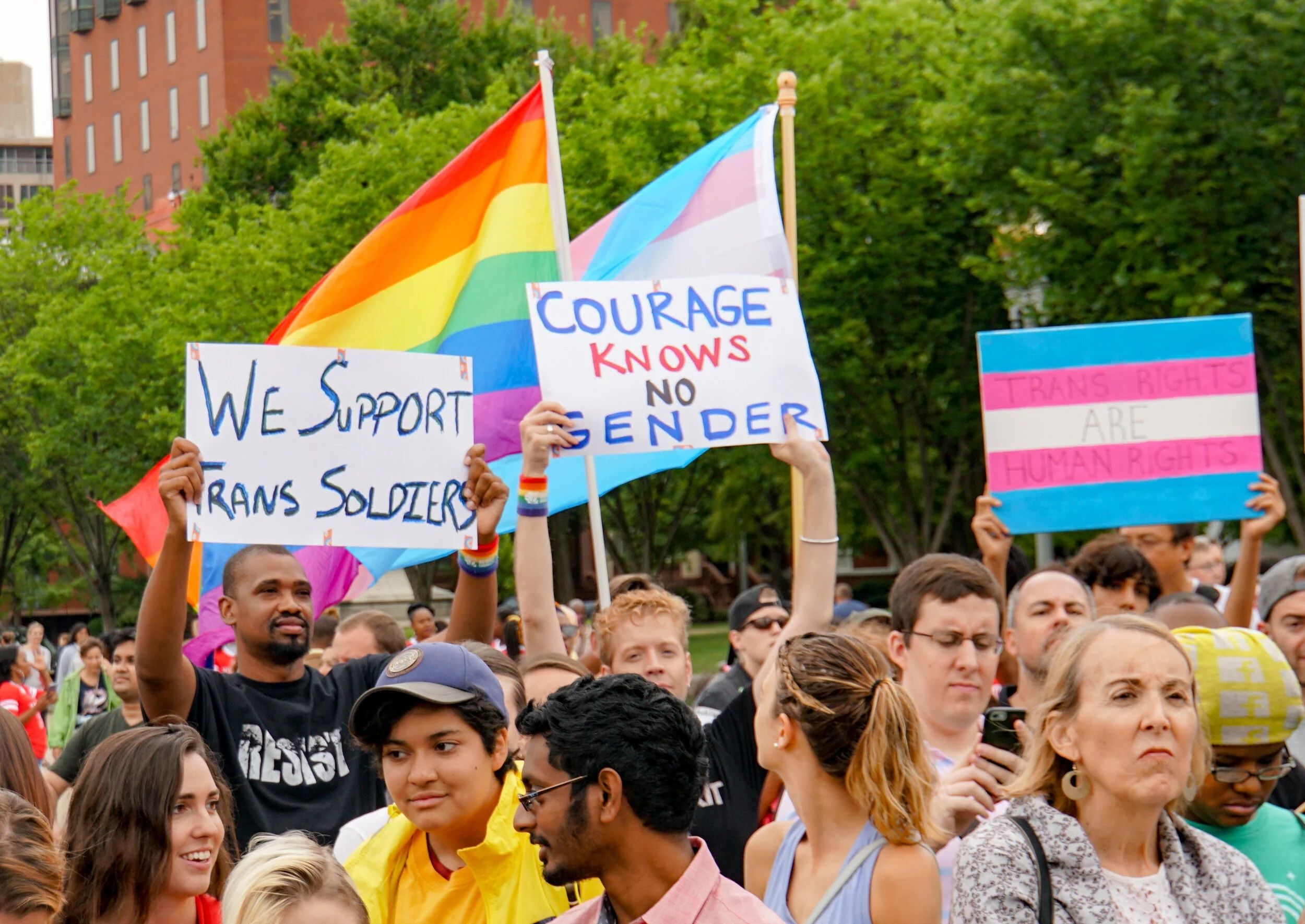
Even after policy reversals, veterans discharged under DADT and related policies face lengthy, complex processes to upgrade their discharge status and access earned benefits.
Military personnel earned their benefits through years of service. These benefits include pensions, education benefits, mortgage benefits, and healthcare benefits—forms of compensation that are being denied on the basis of sexual orientation or gender identity.
Recent discrimination protections... sort of
The last 30 years have seen some improvements in policy and legal support.
President Clinton signed Executive Order 13087 in 1998, prohibiting discrimination based on sexual orientation in the federal civilian workforce.[9][9] U.S. Equal Employment Opportunity Commission. “Executive Order 13087.” It was a meaningful step, but it covered only federal employees, had limited enforcement mechanisms, and did not include gender identity.
President Obama then expanded these protections in 2014 with Executive Order 13672, which added gender identity to the federal workforce protections and extended both sexual orientation and gender identity protections to employees of federal contractors.[10][10] The White House President Barack Obama. “President Obama Signs New Executive Order to Protect LGBT Workers.”
Notable EEOC administrative rulings
Meanwhile, the Equal Employment Opportunity Commission was building its own legal framework.
In 2012, the EEOC ruled in Macy v. Holder that transgender discrimination violates Title VII of the Civil Rights Act. In 2015, it ruled that sexual orientation discrimination does as well.
But these were administrative rulings, not Supreme Court precedent, and they were challenged across federal circuits. The result was a patchwork: a queer worker’s legal protections depended almost entirely on where they lived.
Bostock v. Clayton County
On June 15, 2020, the Supreme Court decided Bostock v. Clayton County in a 6-3 ruling. Justice Gorsuch, writing for the majority, held that discrimination on the basis of sexual orientation or gender identity is inherently discrimination “because of sex” under Title VII of the Civil Rights Act of 1964.[11][11] Cornell Law Institute. “Bostock v. Clayton County.”
The ruling extended federal workplace protections to LGBTQ+ employees at companies with 15 or more workers in all 50 states.
Bostock v. Clayton County consolidated three cases:
- Gerald Bostock, a child welfare coordinator in Georgia, was fired after telling a coworker he had joined a gay recreational softball league.
- Donald Zarda, a skydiving instructor in New York, was fired after mentioning he was gay.
- Aimee Stephens, a funeral home director in Michigan, was fired after informing her employer she was transgender.
Bostock covers hiring, firing, and terms of employment under Title VII, but it does not address all forms of workplace discrimination. Religious exemptions remain a contested area.
Small employers with fewer than 15 employees are not covered. And enforcement depends on workers knowing their rights and being willing to file complaints, something many LGBTQ+ workers are understandably hesitant to do.
LGBTQ+ workplace discrimination remains widespread. A 2024 report from the Center for American Progress found that nearly half of LGBTQ+ workers have experienced discrimination at some point in their careers, with 17% reporting discrimination in the past year alone.[12][12] Center for American Progress. “The LGBTQI+ Community Reported High Rates of Discrimination in 2024.” The rates are higher for transgender workers and LGBTQ+ people of color.
Workplace discrimination costs us money and peace
Unwelcoming workplaces don't just affect us financially. They also contribute to the higher rates of anxiety, depression, and substance use we see among LGBTQ+ workers. (Queer tax!)
Healthcare costs go up.
Productivity goes down.
People leave careers they’re good at for environments that simply feel safe.
This is why I do what I do. I want LGBTQ+ people to feel like they have control over their financial futures.
Sometimes, that means taking matters into your own hands, whether that be getting a new job or going into business for yourself. And it definitely means learning about the systems around us and our legal rights so we can better protect ourselves.
My hope is you learned something new about the history of queer workplace discrimination from this post. I certainly did while writing it, and appreciate you taking the time to read. ⬥