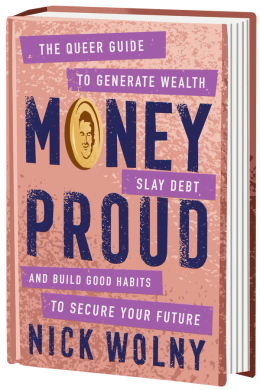



Writing my first book Money Proud in 2024 kind of broke me as a writer. At the time, I’d written and edited online for about ten years, in a variety of formats. From sales pages to articles, for both myself and clients, I mainly wrote stuff intended to be read on the internet, and would consider that the bulk of my professional writing experience.
An 80,000-word manuscript is the opposite of all this. No one cares if the subheadings are formatted correctly for Google’s crawl bots, or if the newsletter font size is too small, or if we answered who-what-where-when-why-how in the first two paragraphs. For a book manuscript, it’s just you, an idea, and a blank page. Many blank pages. Books are long AF. Books are marathons.
Writing a book for a big publisher forced me to change my creative process. It wasn’t going to be enough to simply organize information and mix in a few funnies. I had to clarify a style of writing that is interesting, replicable, and sounds like how I talk. A voice. I’d previously had glimmers of this voice in my writing, mostly in finance columns for Out magazine. But in writing Money Proud, my repeatable recipe emerged. (If you must know the nerdy details behind my process, I will put them in footnotes.) 1 2 3 4 I have ADHD, take me to the footnotes right now
Cooking up this voice takes time. The meat has to marinate for hours. The dressings and sauces are made from scratch. And we’re obviously gonna plate the bejesus outta this entrée so that it’s highly Instagrammable. My creative process takes longer now, and is therefore slower.
It was easy to access this voice in Money Proud because I spent months and months stewing over the same material. But when I went back to writing articles and newsletters, and tried to follow my fancy new voice recipe, it didn’t work. Everything I wrote, um… sucked?! The ideas were half-baked. The paragraphs were under-seasoned. And where were all the JOKES?
[IMAGE] Trinity GIF where are the jokes
Then I went back and looked at all the stuff I’d written in the past. And I realized it wasn’t that my writing sucked. (A lot of it did, though. It’s fine! We can laugh about it now! #selftaught) It was that I have this new writing voice that takes a long time to cook. My voice requires more than information alone; it also requires style and story.
Organizing information (which AI now does pretty well on command, albeit with varying degrees of accuracy) is different from telling a story. Storytelling has rhythm, mechanics, speed. Interpretation. In a story, there is emotion. There is humanity. I still like curating information for readers, and will continue to do so. But given recent advancements in technology, curation alone is not as special as it used to be. The style of the curation matters more, and storytelling is one aspect of style.
Unfortunately, the machinery of the internet doesn’t care that much about style or storytelling. Humans care about style; algorithms, not so much. Algorithms use various criteria to look for things like relevance and credibility, then make snap judgements about what information should be surfaced to whom. This is search engine marketing in a nutshell, and it’s hugely influential in who sees what when they’re browsing online.
We like the internet because it helps us access information we might not have otherwise discovered. But as many writers know, the type of content that gets found and surfaced by search engines is often completely divorced from creative writing, literary excellence, and other categories of creative nonfiction and filmmaking.
What if you want to be creative, but also want your writing to be seen and heard? After writing Money Proud, a work entirely detached from internet visibility, internet writing doesn’t taste as good anymore. But it is what gets seen. And audience is an important aspect of this author-writer-creator-knowledge worker thing many of us do for a living.
Hub-column-spoke
Hubspot refers to search engine marketing visibility as a topic cluster. In a topic cluster, a website has hubs and spokes. Hubs are the pillars of the blog; they’re big, juicy, overview pieces that pitch a big idea. Spokes are smaller, more niche posts, designed to answer questions and create links to one another and the hub. Kinda like a spiderweb.
[SPIDERWEB GIF]
When search engines crawl websites and see spiderwebs, they’re like “Got it, here’s a topic this website consistently covers.” Spokes needn’t be imaginative; they answer questions, cite sources, and increase the chances a website will surface in search engines for the given topic.
I like the hub-spoke approach. But it doesn’t leave much space for creative writing (Where will I do my jazz hands?). So I took a more hybrid interpretation: hub-column-spoke. I want to live in between big-idea hubs and snacky little spokes, and write columns in my voice, independent from the pressures of internet optimization, but still discoverable to website visitors and passersby. Ideally, a person browsing the internet on a topic — LGBTQ+ personal finance, for example — arrives on my website thanks to the spokes, finds their way to columns, and lands on a newsletter.
I’m a columnist, not a spoke-ologist (Spokesperson?). I’m here to write columns and essays that explore ideas deeply. And I’m not interested in having AI write things for me. The reason I got into writing and editing is because I enjoy the craftwork of writing and editing. But I do use AI in other ways to free up more time for writing. So here’s an overview of how I do that for content in newsletters and on this website.
AI policy and use cases
Here’s how AI is currently used on nickwolny.com.
Research for spoke posts
Spoke posts, as described above, are short, question-answer posts designed to show up in search engines. I use agentic AI tools (Claude Cowork, Gemini) to research sources for spoke posts, suggest queries relevant to the topic, and outline headlines and subheadlines. I then review and consider this information, fact-check it for accuracy, and edit or rewrite the summaries. Sometimes, I take most of the suggestions, and the edits are light. Other times, I take none of them. Usually, it’s somewhere in the middle. For fact checks, I vet the information source, the source’s sources, and the organization that published the information. The final draft of these posts is most often a series of question-answer blocks, cited where necessary, with a summary lede at the top.
Spoke posts are expository. They spit facts (which, again, are fact-checked and cited), answer questions, link to outside sources, and… that’s about it. We’re not painting the sunset; that’s what columns are for. The purpose of a spoke post is to communicate existing information for readers. My job in a spoke post is to curate this information clearly and accurately. I disclose at the top of spoke posts that AI was used for some of the production of the post, and link back to this web page. This is in addition to the standing disclosures for all posts that the content is for educational purposes only, and is not financial, legal, or medical advice.
[IMAGE]
Spoke editing helps me research potential columns. I draft most of the spokes for a column before starting on the column itself because I find that editing and interrogating spokes helps me wrap my head around a topic. I learn what literature is available both online and offline about said topic, which kickstarts the column-research process. I know enough to know I don’t know everything, and I often learn about new topics and organizations while fact-checking spokes.
Separately, this website uses minimal tracking pixels (Google Analytics for traffic reporting), so visitors either get the information they need and then leave, or, ideally, learn about a column through a spoke, click through, think to themselves, “Hey, I kinda like this dude,” and perhaps sign up for my newsletter, which is the goal.
[Newsletter box]
Website design tweaks
My website design is an extension of newsletter graphics I had designed back in 2023.
I’ve commissioned San Diego illustrator Kevin Sterjo for many projects over the years. I originally found him on Upwork during the COVID-19 lockdowns, and we have great rapport. For Financialicious, I knew that I wanted to have space to talk about lots of different topics relating to money, technology, and LGBTQ+ culture. Organized chaos, if you will. He expertly translated these wishes into a fun header graphic and some dividers. The color palettes are a reference to the many different colors of monetary currency.
[IMAGE]
I love this concept. So, I use agentic AI (Claude Cowork) to code boxes and callouts on my website with a similar inspiration. These tweaks are often too small for a developer or designer scope. I’ve also used it to custom-code the front end of landing pages, as well as my course portal. Membership login is through a secure third-party integration, newsletter management is through an established provider (Kit), and payments are taken through Stripe to ensure anything that handles user information is airtight.
Kevin recommended my heading typography (Bricolage Grotesque Extra Bold), which I like for its modern feel. I use Roboto for body font because it’s easy to read on a phone. On my end, as a copy editor, I departed AP style for Chicago style a couple years ago, with a few exceptions for web publishing, because I wanted a more literary feel.
Tertiary sourcing
Last, I sometimes use agentic AI as a tertiary source.
A tertiary source is a source that references other primary and secondary sources. Examples of tertiary sources would be Wikipedia, or some textbooks. A tertiary source doesn’t meet academic standards for citation, but most agree they can be helpful for pointing you toward primary and secondary sources you may not have discovered otherwise. In most cases, the behavior is similar to web search.
***
I know I’m not the only person grappling with AI, its ethics, and its immediate disruption to many aspects of our lives. I know that me using it at all will anger some people. (I also know quite a few people who rage about it online, but quietly use it themselves constantly.)
What works for me is to be transparent and share this with you now upfront. By setting policies for myself and sharing them publicly, I hold myself accountable, feel more comfortable in my overall creative process, and can perhaps encourage others to establish similar guardrails for themselves. ⬥
1 Biggest change is that I do a syntax pass to get all the sentences and paragraphs how I want them, and then I go back through and add humor and tone later. This is because the type of zinger or joke I put in has to fit the flow of the current paragraph. My rule of thumb is that every paragraph needs at least one voice-y something, unless it’s about a serious topic. This is way more density than I was doing previously. I can’t rush the jokes, so this part takes ages, I’ve learned.
2 I was a snob about parentheticals for a long time (you’re interrupting yourself!), but I’m softer about it now. My parentheticals are the sassy co-host, a second voice that creates counterpoint. In a way, my writing voice is two sides of my personality yapping with one another. Also, stage directions can be hilarious.
3 Time management was a challenge in the book-writing process because I was on deadline (I had seven months to write it, on top of a day job, which I thought was horribly fast, but is apparently standard). As I edited, if a section or a paragraph wasn’t working, and I knew it wasn’t working, but couldn’t put my finger on why within a few minutes, I’d just highlight it and move on. This became my productivity management solution to hit my checkpoints on time. I think of each paragraph as a project now, so when I’m stuck on one, I punt it and move on. Usually, the reason for the mental block is that I’m tired.
4 I worried that Money Proud came out too voice-y, and would be interpreted as unserious. But the feedback has been the opposite — the voice is many readers’ favorite part, and critics like this voice-forward take on what is historically a dry topic.